The 1995 season saw a championship battle between Michael Schumacher in the Benetton-Renault B195 and Damon Hill in the Williams-Renault FW17. Jean Alesi in the Ferrari 412T2 was also a serious contender during the first half of the season, but a run of mechanical failures at four successive races scuppered his chances. Damon Hill had a difficult second half of the season and made numerous errors, which allowed Schumacher to pull clear and win the championship quite comfortably.
So how did the drivers rank this year? All will be revealed...
So how did the drivers rank this year? All will be revealed...
Statistics for 1995, including drivers' race by race ratings
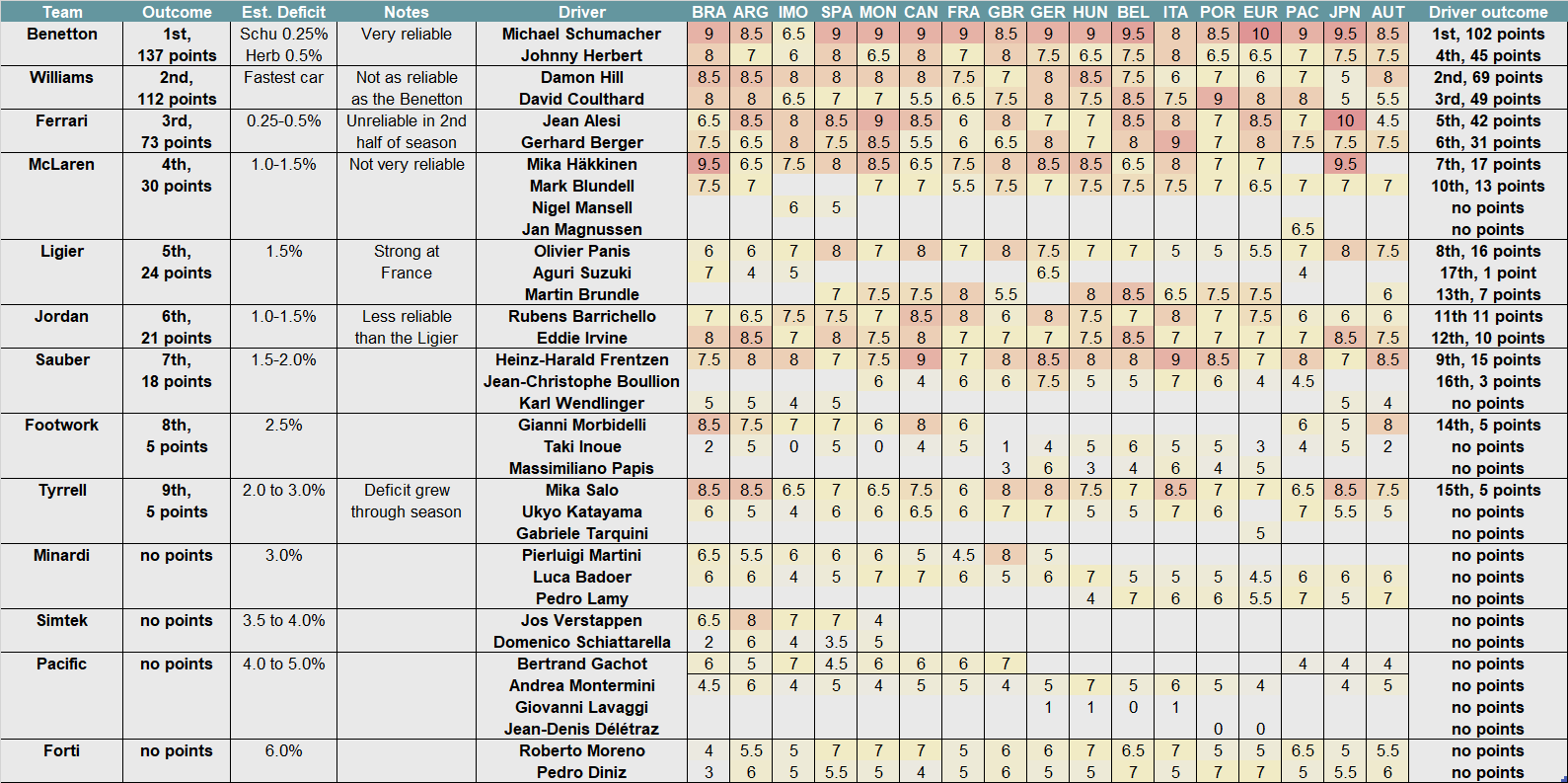
Ratings for first half of 1995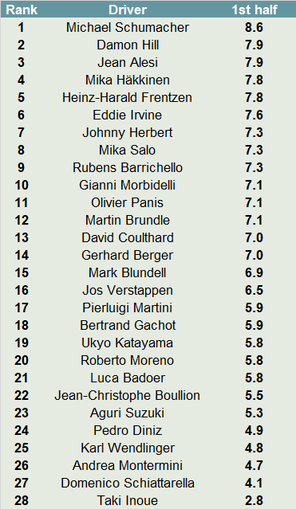
|
Ratings for second half of 1995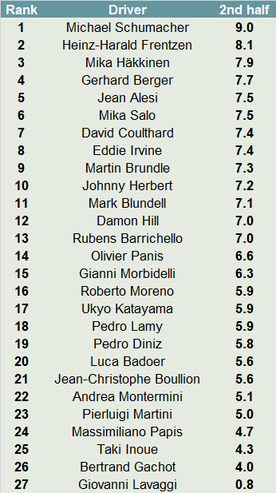
|
Overall ratings for 1995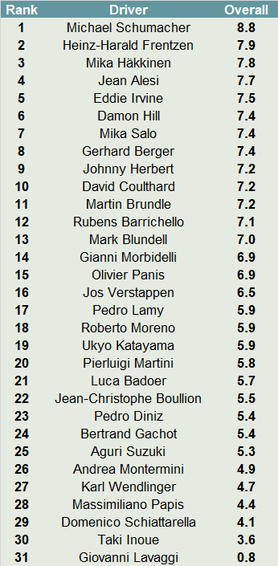
|
Ferrari
Ferrari produced a very competitive car in 1995, though it was very unreliable mid to late season.
Jean Alesi had an excellent run of form early in the season which culminated in his popular win on his birthday at Canada, and for a time he became a serious contender for the drivers' championship. However, he tended to underachieve in qualifying, and when it became clear that Ferrari was seeking to replace him, his form in the races returned to being somewhat erratic. There were several brilliant wet weather performances in there, notably at Japan, but also several average performances where he clearly wasn't close to getting the best out of the Ferrari. He was unlucky to only win one race, though.
Gerhard Berger was rather disappointing in the first half of the season. He usually qualified well, but tended to drop away in the races. In the one race where he was very competitive - San Marino - he stalled in the pitlane. He was better in the second half of the season, but still tended to be solid rather than spectacular. The highlights were a superb wet weather qualifying performance at Belgium which put him on pole, and a strong drive at Italy, where he had a slight edge over Jean Alesi (who usually goes very well at Monza) and looked likely to win, but the camera fell off Jean Alesi's car and wrecked his suspension.
Jean Alesi had an excellent run of form early in the season which culminated in his popular win on his birthday at Canada, and for a time he became a serious contender for the drivers' championship. However, he tended to underachieve in qualifying, and when it became clear that Ferrari was seeking to replace him, his form in the races returned to being somewhat erratic. There were several brilliant wet weather performances in there, notably at Japan, but also several average performances where he clearly wasn't close to getting the best out of the Ferrari. He was unlucky to only win one race, though.
Gerhard Berger was rather disappointing in the first half of the season. He usually qualified well, but tended to drop away in the races. In the one race where he was very competitive - San Marino - he stalled in the pitlane. He was better in the second half of the season, but still tended to be solid rather than spectacular. The highlights were a superb wet weather qualifying performance at Belgium which put him on pole, and a strong drive at Italy, where he had a slight edge over Jean Alesi (who usually goes very well at Monza) and looked likely to win, but the camera fell off Jean Alesi's car and wrecked his suspension.
Some "what ifs" around Schumacher, Senna and the 1995 Ferrari
A big question is, "what would Michael Schumacher have achieved in this car?", especially as Schumacher spoke very highly of it when he tested it afterwards at Estoril, Portugal. My view is that had Schumacher been in the 1995 Ferrari, he would have come close to winning the drivers' championship, but that it could have been very detrimental to his career.
In the first half of the season, he would probably have done as well as he did in the Benetton, taking a slender lead in the drivers' championship. However, in the second half of the season, he would have repeatedly broken down while in potentially race winning positions, and most likely lost his championship lead. This, combined with the internal disharmony at Ferrari, may have tested even Schumacher's patience, especially considering that he was still relatively inexperienced in 1995.
Had Ayrton Senna gone to Ferrari for 1995 (Ferrari had offered him a contract for 1995), it could have been even more explosive, but my suspicion is that, for various reasons, had Senna still been around, he would probably have stayed at Williams in 1995 and switched to Ferrari for 1996, while Michael Schumacher would probably have ended up at McLaren.
In the first half of the season, he would probably have done as well as he did in the Benetton, taking a slender lead in the drivers' championship. However, in the second half of the season, he would have repeatedly broken down while in potentially race winning positions, and most likely lost his championship lead. This, combined with the internal disharmony at Ferrari, may have tested even Schumacher's patience, especially considering that he was still relatively inexperienced in 1995.
Had Ayrton Senna gone to Ferrari for 1995 (Ferrari had offered him a contract for 1995), it could have been even more explosive, but my suspicion is that, for various reasons, had Senna still been around, he would probably have stayed at Williams in 1995 and switched to Ferrari for 1996, while Michael Schumacher would probably have ended up at McLaren.
The top five
1. Michael Schumacher (Benetton)
Michael Schumacher had an outstanding season in 1995. There were some asterisks against his championship win in 1994, with question marks over the legality of his Benetton and his somewhat questionable move on Damon Hill to protect his championship lead at Australia 1994. But in 1995 there was no doubt that he thoroughly deserved to be World Champion.
His season got off to a relatively shaky start, as he was beaten by Damon Hill's Williams at Brazil and Argentina, and he crashed out while pushing hard at San Marino. But from Spain through to Germany inclusive (rounds 4 to 9), he was consistently the man to beat, despite being in a Benetton that wasn't quite as fast as the Williams and often wasn't significantly faster than the Ferrari. He often qualified behind Damon Hill, but outgunned him in the races due to a mix of his superiority as a driver and superior race strategies from the Benetton team.
He came close to getting the full 10 rating for an excellent wet weather drive at Belgium, but I docked him a mark because some of his defensive moves on Damon Hill pushed the bounds of fair play, while not being clearly out of order. But he got a 10 rating for his comeback drive at the European GP at the Nürburgring, recovering a large deficit to Jean Alesi's Ferrari and passing him near the end with a forceful but fair overtaking move. During the back end of the season he was relentlessly fast and almost flawless.
Michael Schumacher had an outstanding season in 1995. There were some asterisks against his championship win in 1994, with question marks over the legality of his Benetton and his somewhat questionable move on Damon Hill to protect his championship lead at Australia 1994. But in 1995 there was no doubt that he thoroughly deserved to be World Champion.
His season got off to a relatively shaky start, as he was beaten by Damon Hill's Williams at Brazil and Argentina, and he crashed out while pushing hard at San Marino. But from Spain through to Germany inclusive (rounds 4 to 9), he was consistently the man to beat, despite being in a Benetton that wasn't quite as fast as the Williams and often wasn't significantly faster than the Ferrari. He often qualified behind Damon Hill, but outgunned him in the races due to a mix of his superiority as a driver and superior race strategies from the Benetton team.
He came close to getting the full 10 rating for an excellent wet weather drive at Belgium, but I docked him a mark because some of his defensive moves on Damon Hill pushed the bounds of fair play, while not being clearly out of order. But he got a 10 rating for his comeback drive at the European GP at the Nürburgring, recovering a large deficit to Jean Alesi's Ferrari and passing him near the end with a forceful but fair overtaking move. During the back end of the season he was relentlessly fast and almost flawless.
4. Jean Alesi (Ferrari)
After a difficult 1994 season when he let frustration take over, and a rather average performance at Brazil, Jean Alesi turned things around very well early in the season. He was a serious threat to leader Damon Hill at Argentina, battled with David Coulthard at San Marino and led the pursuit of Michael Schumacher at Spain, Monaco and Canada, culminating in his win of the Canadian GP on his birthday. France was a bit ragged, but he put in another good performance at the British GP, going from 6th to 2nd at the start and finishing second. At last, Jean Alesi was achieving his dream of mounting a serious championship challenge with Ferrari.
But it proved to be too little, too late, as by the German GP it was becoming increasingly clear that Ferrari didn't want to retain him for 1996. It had a large psychological effect on him, and in the second half of 1995 his performances were somewhat erratic. He was unlucky not to win another race or two, as he was brilliant in the wet at Belgium, the Nürburgring and (especially) Japan, and also looked set to win at Italy before his wheel bearing failed late on. At Japan, he got a questionable jump start penalty and then charged through the field on slicks on a drying track and battled with Michael Schumacher for the lead. However, he also put in a number of rather average performances. In contrast to his Japan heroics, at Australia he was off the pace and made a bizarre misjudgement that took out himself and Schumacher. He was partly to blame for losing a big lead at the Nürburgring, and also underachieved somewhat in qualifying for much of the season (indeed, Gerhard Berger outqualified him 12-5).
Overall, Jean Alesi had a good season in 1995, but not as good as many observers (myself included) thought at the time, as many didn't appreciate how competitive the 1995 Ferrari was. Michael Schumacher reckoned, when testing it afterwards, that it was good enough to win the drivers' championship. My view is that a Schumacher/1995 Ferrari combination would probably have been fast enough to win the championship, but that the car's unreliability mid to late season would probably have scuppered his chances.
After a difficult 1994 season when he let frustration take over, and a rather average performance at Brazil, Jean Alesi turned things around very well early in the season. He was a serious threat to leader Damon Hill at Argentina, battled with David Coulthard at San Marino and led the pursuit of Michael Schumacher at Spain, Monaco and Canada, culminating in his win of the Canadian GP on his birthday. France was a bit ragged, but he put in another good performance at the British GP, going from 6th to 2nd at the start and finishing second. At last, Jean Alesi was achieving his dream of mounting a serious championship challenge with Ferrari.
But it proved to be too little, too late, as by the German GP it was becoming increasingly clear that Ferrari didn't want to retain him for 1996. It had a large psychological effect on him, and in the second half of 1995 his performances were somewhat erratic. He was unlucky not to win another race or two, as he was brilliant in the wet at Belgium, the Nürburgring and (especially) Japan, and also looked set to win at Italy before his wheel bearing failed late on. At Japan, he got a questionable jump start penalty and then charged through the field on slicks on a drying track and battled with Michael Schumacher for the lead. However, he also put in a number of rather average performances. In contrast to his Japan heroics, at Australia he was off the pace and made a bizarre misjudgement that took out himself and Schumacher. He was partly to blame for losing a big lead at the Nürburgring, and also underachieved somewhat in qualifying for much of the season (indeed, Gerhard Berger outqualified him 12-5).
Overall, Jean Alesi had a good season in 1995, but not as good as many observers (myself included) thought at the time, as many didn't appreciate how competitive the 1995 Ferrari was. Michael Schumacher reckoned, when testing it afterwards, that it was good enough to win the drivers' championship. My view is that a Schumacher/1995 Ferrari combination would probably have been fast enough to win the championship, but that the car's unreliability mid to late season would probably have scuppered his chances.
Some commentary quotes from 1995
Eddie Irvine has a strong run early in the Spanish Grand Prix:
Murray Walker: And so, Schumacher leads. Alesi is second. Coulthard is third. Berger is fourth. Eddie Jordan is up into fifth position.
Michael Schumacher and Damon Hill battle hard at the Belgian Grand Prix:
Murray Walker: Now, this is the chance for Damon Hill, this is where I said, but Schumacher's going to try and cut him off, Hill is alongside him... and goes through... Noooooooo! Schumacher still marginally ahead! Pushes Hill... Pushes Damon Hill sideways and retaining his line!
Murray Walker was temporarily speechless when Michael Schumacher forced his way past Jean Alesi near the end of the European Grand Prix:
Murray Walker: Yeeeeessss! Michael Schumacher takes the lead in the Grand Prix of Europe and the Benetton team go beserk with delight!
And David Coulthard crashes into the pit lane entry at the Australian Grand Prix:
Murray Walker: And into the pit lane... OOOOOOOOOOOOHHHH... My goodness! David Coulthard... smashes himself out of the Austral - I have never seen that before!
Benetton-Renault B195
They didn't have the fastest car, but it was the most reliable, and the Benetton team regularly outperformed the Williams team when it came to race strategies and pit stops.
Above all, they had Michael Schumacher, who had an outstanding season in 1995. He got off to a relatively shaky start, crashing out at San Marino, but from the Spanish Grand Prix onwards he was almost flawless. He often qualified behind one or both Williams drivers, but they were rarely able to keep up with his relentless race pace.
Johnny Herbert was compromised in a team heavily focused on Schumacher, but he kept out of trouble and picked up a couple of opportunistic wins at Britain and Italy.
Above all, they had Michael Schumacher, who had an outstanding season in 1995. He got off to a relatively shaky start, crashing out at San Marino, but from the Spanish Grand Prix onwards he was almost flawless. He often qualified behind one or both Williams drivers, but they were rarely able to keep up with his relentless race pace.
Johnny Herbert was compromised in a team heavily focused on Schumacher, but he kept out of trouble and picked up a couple of opportunistic wins at Britain and Italy.
Williams-Renault FW17
Williams had the fastest car, but it wasn't as reliable as the Benetton and both the team and the drivers made numerous errors, which cost them the constructors' championship as well as the drivers' championship.
Damon Hill started off the season strongly, though he did not quite have Michael Schumacher's ultimate pace. At Spain, Monaco and Canada, mechanical gremlins held him back and contributed to him falling behind Jean Alesi as well as Schumacher in those races. As Schumacher took command mid to late season, he made numerous errors under pressure, notably spinning out in the wet at the European and Japanese Grands Prix, which contributed to him getting replaced by Heinz-Harald Frentzen for 1997.
David Coulthard was increasingly quick - for much of the second half of 1995 he was quicker than Damon Hill - but he made numerous errors, most infamously spinning out on the parade lap at Italy and crashing when entering the pit lane at the Australian Grand Prix. He also suffered more mechanical unreliability than Hill.
Damon Hill started off the season strongly, though he did not quite have Michael Schumacher's ultimate pace. At Spain, Monaco and Canada, mechanical gremlins held him back and contributed to him falling behind Jean Alesi as well as Schumacher in those races. As Schumacher took command mid to late season, he made numerous errors under pressure, notably spinning out in the wet at the European and Japanese Grands Prix, which contributed to him getting replaced by Heinz-Harald Frentzen for 1997.
David Coulthard was increasingly quick - for much of the second half of 1995 he was quicker than Damon Hill - but he made numerous errors, most infamously spinning out on the parade lap at Italy and crashing when entering the pit lane at the Australian Grand Prix. He also suffered more mechanical unreliability than Hill.
Ferrari 412T2
The 1995 Ferrari was very competitive, probably on a par with the Benetton for speed, but after a good reliability record in the first half of the season, it became very unreliable in the second half, which killed off Jean Alesi's championship challenge.
Jean Alesi turned things around very well in early 1995 after his troubled 1994 season. He had a superb run of form from Argentina through to Canada, which culminated in his one Grand Prix win, fittingly at Canada on his birthday in the #27 Ferrari that Gilles Villeneuve made famous. But then it became clear that Ferrari were seeking to replace him for 1996, and I think it affected his driving - he often tried too hard and over-drove and became inconsistent, especially in qualifying. However, he produced some outstanding wet weather drives late on, particularly at Japan.
Gerhard Berger had a disappointing season, where he had an appalling run of bad luck with the team's operational mishaps and seemed to lose heart for a time. He performed well in the second half of the season, but unreliability prevented him from getting good results. He was excellent at the Italian Grand Prix and was denied a likely victory when the camera fell off Jean Alesi's car and damaged his suspension.
Jean Alesi turned things around very well in early 1995 after his troubled 1994 season. He had a superb run of form from Argentina through to Canada, which culminated in his one Grand Prix win, fittingly at Canada on his birthday in the #27 Ferrari that Gilles Villeneuve made famous. But then it became clear that Ferrari were seeking to replace him for 1996, and I think it affected his driving - he often tried too hard and over-drove and became inconsistent, especially in qualifying. However, he produced some outstanding wet weather drives late on, particularly at Japan.
Gerhard Berger had a disappointing season, where he had an appalling run of bad luck with the team's operational mishaps and seemed to lose heart for a time. He performed well in the second half of the season, but unreliability prevented him from getting good results. He was excellent at the Italian Grand Prix and was denied a likely victory when the camera fell off Jean Alesi's car and damaged his suspension.
McLaren-Mercedes MP4/10
McLaren was again off the pace in 1995, despite securing Mercedes engines (which turned out to be an excellent long-term investment).
I believe that Mika Häkkinen was the second fastest driver on the grid in 1995 (after Michael Schumacher),when taking the deficiencies of his McLaren into account. He was outstanding at his first and last races, at Brazil and Japan. However, he ranked below Heinz-Harald Frentzen overall because he made more mistakes, which included punting off Johnny Herbert at Canada and spinning out early in the Belgian GP. He had a near-fatal accident in qualifying at Australia, but the track marshals were able to save his life and he went on to make a near-full recovery.
Mark Blundell was not generally able to match Häkkinen's pace, though he did unexpectedly outqualify him at the Portuguese GP and came close to doing so again at the European GP. He was pretty competent and made few mistakes, picking up points from time to time.
Jan Magnussen did a pretty good job when deputising for Mika Häkkinen at the Pacific GP.
Sadly Nigel Mansell's comeback was a disaster, as he struggled with the car, couldn't match Häkkinen's speed and got into quite a few incidents.
I believe that Mika Häkkinen was the second fastest driver on the grid in 1995 (after Michael Schumacher),when taking the deficiencies of his McLaren into account. He was outstanding at his first and last races, at Brazil and Japan. However, he ranked below Heinz-Harald Frentzen overall because he made more mistakes, which included punting off Johnny Herbert at Canada and spinning out early in the Belgian GP. He had a near-fatal accident in qualifying at Australia, but the track marshals were able to save his life and he went on to make a near-full recovery.
Mark Blundell was not generally able to match Häkkinen's pace, though he did unexpectedly outqualify him at the Portuguese GP and came close to doing so again at the European GP. He was pretty competent and made few mistakes, picking up points from time to time.
Jan Magnussen did a pretty good job when deputising for Mika Häkkinen at the Pacific GP.
Sadly Nigel Mansell's comeback was a disaster, as he struggled with the car, couldn't match Häkkinen's speed and got into quite a few incidents.
Ligier Mugen-Honda J541
Ligier produced a pretty decent car in 1995, though it was a fair way off the pace of the Williams.
Olivier Panis showed decent pace and finished a strong second at the Australian GP despite having engine problems late on. He didn't make my top ten drivers for 1995 because he was generally outpaced by Martin Brundle and because he had a number of self-inflicted crashes late in the season.
Martin Brundle had a difficult start to 1995. At San Marino and Monaco he was delayed by a refuelling rig problem and a jump start penalty respectively. On both occasions he held up Jean Alesi's Ferrari while trying to make up the lost ground, which Jean took rather too personally. But by Monaco he was already slightly faster than Olivier Panis. He was excellent at France and Belgium, finishing 4th and 3rd at those races, but failed to make my top 10 mainly because he spun out at Britain and Australia.
Aguri Suzuki showed reasonable pace at times and managed to score a point, but generally he was nowhere near as good as the other two Ligier drivers, and he was often obstructive when people were trying to lap him.
Olivier Panis showed decent pace and finished a strong second at the Australian GP despite having engine problems late on. He didn't make my top ten drivers for 1995 because he was generally outpaced by Martin Brundle and because he had a number of self-inflicted crashes late in the season.
Martin Brundle had a difficult start to 1995. At San Marino and Monaco he was delayed by a refuelling rig problem and a jump start penalty respectively. On both occasions he held up Jean Alesi's Ferrari while trying to make up the lost ground, which Jean took rather too personally. But by Monaco he was already slightly faster than Olivier Panis. He was excellent at France and Belgium, finishing 4th and 3rd at those races, but failed to make my top 10 mainly because he spun out at Britain and Australia.
Aguri Suzuki showed reasonable pace at times and managed to score a point, but generally he was nowhere near as good as the other two Ligier drivers, and he was often obstructive when people were trying to lap him.
Jordan-Peugeot 195
The 1995 Jordan was compromised a bit by its Peugeot engine but was quite competitive and was well served by the drivers.
Rubens Barrichello performed quite well for most of the season, but to the surprise of many he was generally outpaced by team mate Eddie Irvine. He had the better of Irvine when the team produced its strongest result, a 2-3 at the Canadian GP, and he would have ranked inside my top 10 had he not had silly spins and crashes at each of the last three races of 1995.
Eddie Irvine was one of the stars of the season, frequently outpacing his highly rated team mate and, in contrast to his 1994, 1996 and 1997 seasons, he made very few mistakes this year. Some badly timed mechanical unreliability and collisions that weren't primarily his fault led to him being marginally outscored by Rubens Barrichello.
Rubens Barrichello performed quite well for most of the season, but to the surprise of many he was generally outpaced by team mate Eddie Irvine. He had the better of Irvine when the team produced its strongest result, a 2-3 at the Canadian GP, and he would have ranked inside my top 10 had he not had silly spins and crashes at each of the last three races of 1995.
Eddie Irvine was one of the stars of the season, frequently outpacing his highly rated team mate and, in contrast to his 1994, 1996 and 1997 seasons, he made very few mistakes this year. Some badly timed mechanical unreliability and collisions that weren't primarily his fault led to him being marginally outscored by Rubens Barrichello.
Sauber-Ford C14
Sauber fell a bit from the pace this year and the car's problems were masked by the strong performances of Heinz-Harald Frentzen.
Heinz-Harald Frentzen ranked as the second best performing driver of 1995, and was particularly strong in the second half of the season. He ran especially strongly at the Canadian and Italian races and was unlucky not to get a strong points finish at Canada. His speed was combined with consistency and remarkably few errors, which is why he ranked ahead of Mika Häkkinen (error-prone) and Jean Alesi (inconsistent). His strong performances in 1995 contributed to him being snapped up by Williams for 1997.
Jean-Christophe Boullion was fast enough to occasionally score points, but generally he was well off the pace.
Sadly, Karl Wendlinger was even further from the pace - he clearly wasn't able to come close to recovering his full ability after that terrible accident at Monaco 1994. Before his accident, he and Frentzen had been evenly matched.
Heinz-Harald Frentzen ranked as the second best performing driver of 1995, and was particularly strong in the second half of the season. He ran especially strongly at the Canadian and Italian races and was unlucky not to get a strong points finish at Canada. His speed was combined with consistency and remarkably few errors, which is why he ranked ahead of Mika Häkkinen (error-prone) and Jean Alesi (inconsistent). His strong performances in 1995 contributed to him being snapped up by Williams for 1997.
Jean-Christophe Boullion was fast enough to occasionally score points, but generally he was well off the pace.
Sadly, Karl Wendlinger was even further from the pace - he clearly wasn't able to come close to recovering his full ability after that terrible accident at Monaco 1994. Before his accident, he and Frentzen had been evenly matched.
Footwork-Hart FA16
Footwork remained a lower midfield team in 1995.
Gianni Morbidelli showed reasonable, if not quite top line, speed, and took a point at Canada and then finished a fine third at the Australian GP, which led to him being overwhelmed by the occasion when on the podium. He was in a similar boat to Martin Brundle in that he had to share his race seat with Massimiliano Papis, despite being vastly better than both Papis and the team's regular driver Taki Inoue.
Massimiliano Papis was somewhat further from the pace, often unable to beat Taki Inoue by more than a second per lap (whereas Morbidelli was typically two to three seconds per lap faster).
Taki Inoue was famous for producing some amusing moments in 1995, which included being run over by the pace car at the Hungarian GP. He was generally a long way off the pace - at two races he was so slow that I gave him a rating of zero. His pace did improve late in the season, but not by enough to make him worthy of a long-term place in Formula One.
Gianni Morbidelli showed reasonable, if not quite top line, speed, and took a point at Canada and then finished a fine third at the Australian GP, which led to him being overwhelmed by the occasion when on the podium. He was in a similar boat to Martin Brundle in that he had to share his race seat with Massimiliano Papis, despite being vastly better than both Papis and the team's regular driver Taki Inoue.
Massimiliano Papis was somewhat further from the pace, often unable to beat Taki Inoue by more than a second per lap (whereas Morbidelli was typically two to three seconds per lap faster).
Taki Inoue was famous for producing some amusing moments in 1995, which included being run over by the pace car at the Hungarian GP. He was generally a long way off the pace - at two races he was so slow that I gave him a rating of zero. His pace did improve late in the season, but not by enough to make him worthy of a long-term place in Formula One.
Tyrrell-Yamaha 023
Tyrrell were quite competitive early in the season, but the cars progressively fell from the pace.
Mika Salo was a revelation at the first two races of 1995, often running in points scoring positions. As the Tyrrell fell from the pace later in the season, it took him a while to start picking up points, but he was frequently very quick. Some might be surprised to see him ranked as high as 7th, but for instance the F1metrics model ranked him even higher than that. Especially as it was his first full season in F1, he did very well with the equipment that he had.
Ukyo Katayama was a big disappointment in 1995. He was mostly outpaced by Mika Salo, and on the occasions when he was able to close-match his team mate, he tended to crash or spin out, so I still generally ended up giving him low marks. It turned out that he had cancer on his back, which may have largely or entirely accounted for his loss of form.
Gabriele Tarquini did a reasonable job under the circumstances when asked to deputise for Ukyo Katayama at the European GP, considering that he had been out of Formula One for over two years. It's a shame Tarquini never got another shot at F1, because he was looking good around mid-1992 prior to the folding of Fondmental.
Mika Salo was a revelation at the first two races of 1995, often running in points scoring positions. As the Tyrrell fell from the pace later in the season, it took him a while to start picking up points, but he was frequently very quick. Some might be surprised to see him ranked as high as 7th, but for instance the F1metrics model ranked him even higher than that. Especially as it was his first full season in F1, he did very well with the equipment that he had.
Ukyo Katayama was a big disappointment in 1995. He was mostly outpaced by Mika Salo, and on the occasions when he was able to close-match his team mate, he tended to crash or spin out, so I still generally ended up giving him low marks. It turned out that he had cancer on his back, which may have largely or entirely accounted for his loss of form.
Gabriele Tarquini did a reasonable job under the circumstances when asked to deputise for Ukyo Katayama at the European GP, considering that he had been out of Formula One for over two years. It's a shame Tarquini never got another shot at F1, because he was looking good around mid-1992 prior to the folding of Fondmental.
Minardi-Ford M195
The Minardi team fell from the pace this year, but it was not helped by its mediocre drivers.
"Mr. Minardi" Pierluigi Martini was nowhere near as fast as he used to be, while Pedro Lamy and Luca Badoer hardly showed top-line pace, though Lamy managed a point in a race of attrition at Australia. Pierluigi Martini gave us a last ditch reminder of what he was previously capable of at the British Grand Prix, though, showing very good speed and finishing seventh, just outside of the points.
"Mr. Minardi" Pierluigi Martini was nowhere near as fast as he used to be, while Pedro Lamy and Luca Badoer hardly showed top-line pace, though Lamy managed a point in a race of attrition at Australia. Pierluigi Martini gave us a last ditch reminder of what he was previously capable of at the British Grand Prix, though, showing very good speed and finishing seventh, just outside of the points.
Simtek-Ford S951
Simtek imploded after the first five races of 1995, struggling to maintain funding.
Having been well served by David Brabham in 1994, the team found another decent but not top line driver in Jos Verstappen, who put in some spirited drives, though he faltered somewhat at the Monaco GP. Domenico Schiattarella was a fair way short of his team mate's pace (except at Monaco).
Having been well served by David Brabham in 1994, the team found another decent but not top line driver in Jos Verstappen, who put in some spirited drives, though he faltered somewhat at the Monaco GP. Domenico Schiattarella was a fair way short of his team mate's pace (except at Monaco).
Pacific-Ford PR02
The Pacific team kept going in 1995, but was well off the pace.
Bertrand Gachot had proved himself to have decent pace in 1991 when in a competitive car, but understandably lost a bit of motivation in 1995 with being in such a slow car. After missing a large chunk of the season, he struggled to regain his former pace at the last three races. Andrea Montermini was rather off the pace but not terrible. The same couldn't be said of Giovanni Lavaggi and Jean-Denis Délétraz, who were both embarrassingly slow and looked somewhat out of their depth in Formula One.
Bertrand Gachot had proved himself to have decent pace in 1991 when in a competitive car, but understandably lost a bit of motivation in 1995 with being in such a slow car. After missing a large chunk of the season, he struggled to regain his former pace at the last three races. Andrea Montermini was rather off the pace but not terrible. The same couldn't be said of Giovanni Lavaggi and Jean-Denis Délétraz, who were both embarrassingly slow and looked somewhat out of their depth in Formula One.
Forti-Ford FG01
The Forti team was a laughing stock, languishing at around 6% off the pace of the Williams, meaning that in subsequent seasons it would often have fallen foul of the 107% rule. Roberto Moreno, like Bertrand Gachot, had proved to have decent speed when he had a competitive car in 1991, but understandably lost some motivation towards the end of 1995, ground down by being in such a slow car. Pedro Diniz was brought in as a pay driver and predictably struggled early on, but he steadily improved. Towards the end of the season he started to outpace Roberto Moreno, which earned him a drive for Ligier for 1996.
"What if" scenarios
#1: Would Michael Schumacher have won the 1995 drivers' championship with the 1995 Ferrari?
Schumacher has been quoted as saying that the 1995 Ferrari was good enough to win a world championship. I believe that in Schumacher's hands it would have been fast enough, but would it have been reliable enough in the second half of the season? I doubt it. Assuming a scenario where Schumacher and Alesi swap seats, I can imagine Schumacher building up a healthy championship lead with this car in the first half of the season, but then seeing it slip away in the second half due to repeatedly breaking down when in race winning positions. This would have tested even Michael Schumacher's patience. He might well have cracked under the pressure and instinctively resorted to dirty tactics such as deliberately taking out Damon Hill.
#2: What if Ayrton Senna had still been alive, and stayed at Williams for 1995?
This scenario would probably have resulted in a straight Schumacher-Senna championship fight, with Hill generally unable to match Senna's pace. I reckon that Senna would have come much closer than Damon Hill did to winning the drivers' championship. However, especially in view of the Williams's dodgy reliability, he would most likely have narrowly lost the title.
#3: What if Ayrton Senna had gone to Ferrari for 1995?
Ayrton Senna had been offered a contract with Ferrari for 1995, probably at the expense of Jean Alesi. Had he taken it up, we could have had a championship battle to savour between Senna and Schumacher in the first half of the season, but Senna's challenge would have faltered in the second half due to the unreliability of the Ferrari. Another interesting "what if" is "where would Jean Alesi have gone". With Schumacher firmly committed to Benetton for 1995, Alesi might well have gone to Williams to partner Damon Hill, where he could have finished ahead of Hill in the drivers' championship, though I think it's very unlikely that he'd have beaten Schumacher.
#4: What if Williams had taken on Nigel Mansell instead of David Coulthard?
I don't think Nigel Mansell would have done significantly better than David Coulthard did. He would probably have made fewer mistakes, but he might well have been slower than Coulthard was in the second half of the season. At 41 years old, Nigel would have suffered some age-related decline and he also lacked recent experience, having been out of F1 throughout 1993 and for most of 1994.